
Learn more about local training programs.
Tune-up races

Many runners like to run a shorter tune-up race some time in the months leading up to their main race. If you are relatively local, check out the Second Wind Running Club race calendar for a list of races in and around Champaign-Urbana. If you live far away, check with your local running club or running store.
Book excerpts
Race sponsor Human Kinetics has many resources of interest to runners. Read some excerpts below.
Determine your weekly mileage

In addition to the important ingredients of success in running, I have come up with what I call basic laws of running. I have designed these laws in hopes of allowing runners of all levels of achievement to be able to optimize the benefits of training. Because runners respond differently to a particular coaching treatment, training program, or environment, these basic laws help evaluate and enhance individual training situations.
- Every runner has specific individual abilities.
- A runner’s focus must stay positive.
- Expect ups and downs; some days are better than others.
- Be flexible in training to allow for the unexpected.
- Set intermediate goals.
- Concentrate on the task at hand.
- Most mistakes in races are made early in the race.
- Training should be rewarding.
- Eat and sleep well.
- Don’t train when sick or injured.
- Chronic health issues should be checked by a professional.
- A good run or race is never a fluke.
Read more from the new edition of Daniels’ Running Formula.
Be a happy runner!
Consistent training is all about developing the aerobic system with easy miles and low-level stress. On top of that, short, fast strides get the running economy positive-feedback loop looping. So, let’s break it down with some sweet, CliffsNotes-style action:
- Do lots of easy running, and your aerobic system and running economy develop over time. Those adaptations are sticky—they don’t go down much with age, and they allow you to run more and run faster.
- Build your speed with short, fast strides and intervals (while avoiding going too hard too often), and your running economy rises like a full moon tide. In the process, it takes the aerobic ship with it, allowing more aerobic development.
- Run more over time, and your aerobic system improves even more. As your economy improves, you get faster without even trying. Do that for a few years, and you can chase breakthroughs rather than marginal gains. That is what we mean by consistent training.
Drills to improve running form

Plantar fasciitis can be such a painful condition that it often prevents any running at all. This sheet of fibrous tissue runs between the metatarsal heads and its insertion in the calcaneus (next to the Achilles tendon). Its weakest part is found at the heel, where it becomes injured. The typical sufferer winces when the underside of the heel is even lightly touched. If the exercises presented in this chapter are ineffective, then a physician’s steroid injection can produce a cure. A better long-term solution, however, is to seek knowledge of why the injury occurred and address that cause.
Run with better form

Six key elements of form assessment represent the biggest influencers of performance, running economy, and risk of injury. Therefore, these six should be measured carefully via video analysis:
- Determination of how far ahead of the body the leg moves during the swing phase of gait and thus calculation of maximum shank angle (MSA)
- Measurement of reversal of swing (ROS), or how far back the shank and foot move from MSA before hitting the ground
- Determination of the ROS-to-MSA ratio (ROS/MSA)
- Measurement of the shank angle at initial impact with the ground (SAT, or shank angle at touchdown)
- Determination of the foot angle at touchdown (FAT)
- -Confirmation of posture
A smartphone with video capabilities or a video camera are necessary to carry out the video analysis. The brand of the device does not matter, but the video instrument must be capable of recording at a rate of no less than 240 fps (frames per second).
Marathon race-day nutrition and hydration
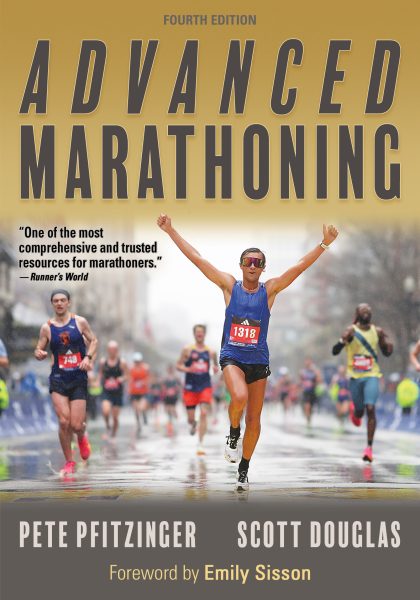
So you’ve followed the advice in this chapter by eating properly and staying well hydrated throughout your months of preparation. Guess what? Your work isn’t done yet. Your strategies for taking calories and fluids on race day can have a strong influence on your marathon performance. Let’s assume you’ve done a good job of glycogen loading during the previous several days and you’re well hydrated. Before the race, you want to take in between 300 and 500 calories of mostly carbohydrate to top off your glycogen stores. It’s best to ingest these calories 3 to 4 hours before the race. This shouldn’t be a big deal for races with late starts, such as New York City or Boston, but for a race such as Chicago, which starts at 7:30 a.m., or Honolulu, which starts at 5:00 a.m. (!), you may have to get up a bit on the early side, eat something, and then try to doze a while longer. (Good luck with that on race morning!) You should also take in about a pint (0.5 L) of fluid to replace fluids lost overnight and ensure that you’re fully hydrated. Even if you carefully carbohydrate load for several days leading up to the marathon, you don’t have much of a buffer against glycogen depletion. The solution is to take in additional calories during the race.